

The Balance Sheet and Profit and Loss
The prescribed forms, why every line prints, and how to read a note reference.
The two faces. Both follow the ICAI's prescribed form, and neither is editable — they are computed from the classifications and entries behind them.
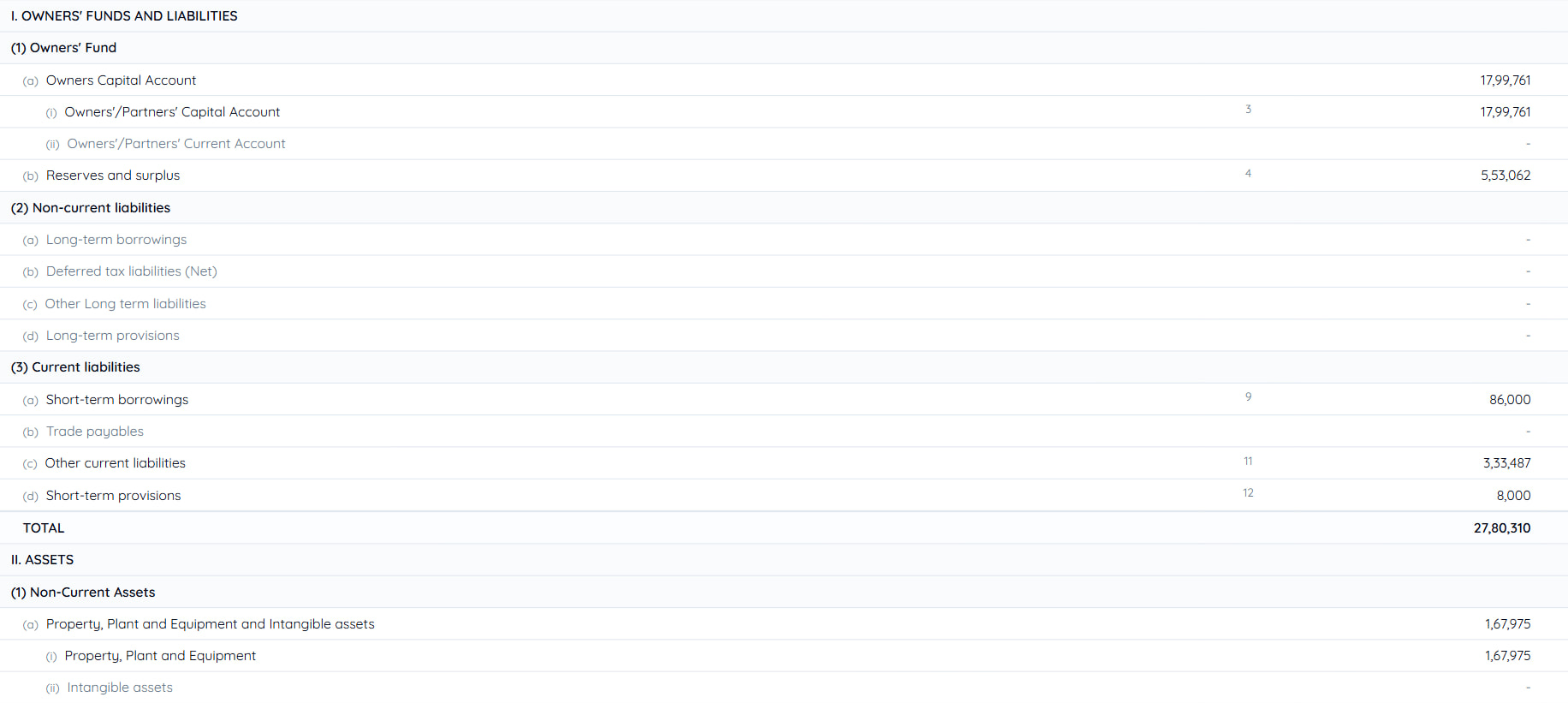
The Balance Sheet
The ICAI's PART I form, in the ICAI's own order and with the ICAI's own numbering.
- Equity and liabilities
Owners' funds, non-current liabilities, current liabilities.
- Assets
- Non-current assets, current assets.
Each of those five groups closes on its own subtotal — an unlabelled bold figure under the group's last line, exactly as Tally's template and a CA-prepared set both print it. The two grand TOTALs are the sums of those subtotals, so the face is arithmetically closed from top to bottom: Owners' funds + Non-current liabilities + Current liabilities on one side, Non-current assets + Current assets on the other.
Note
A group with nothing in it still closes on a subtotal, shown as a dash — the same convention every nil line uses. It is the group closing, not a line that was lost.
The NBFC format is laid out differently
Under Schedule III Division III the face runs assets, then liabilities, then equity, closing on Total Liabilities and Equity. Within assets and within liabilities the lines are grouped financial and non-financial, and there is no current and non-current split anywhere — the format does not offer one. Four borrowing lines stand where the other formats print a single Borrowings: debt securities, borrowings other than debt securities, deposits and subordinated liabilities.
And so is the NPO format
A not-for-profit organisation's Balance Sheet is Sources and Application of
Funds: I SOURCES OF FUNDS — NPO Funds, non-current liabilities, current
liabilities — closing on TOTAL, then II APPLICATION OF FUNDS closing on
TOTAL, and the two agree. NPO Funds open it, in two lines, unrestricted
and restricted, where the other formats print capital or shareholders' funds.
It is a single column per period and always will be: the Guide is explicit
that an NPO's balance sheet is not presented in multi-columnar form, and that
an integrated balance sheet for the organisation as a whole is presented
instead. The fund split belongs to the Income and Expenditure Account and to
note 3. The lines say Payables and Receivables rather than trade payables
and trade receivables, because an NPO is owed donations and grants.
Every prescribed line prints
Whether or not there is a figure against it. A line reading nil is information — it says the entity has none of that thing — and a reader working down the form finds the same rows in the same order in every set of statements they open.
Note
This is why the face can look longer than the entity warrants. It is the prescribed form, not a summary of what happens to have a balance.
Reading a note reference
Each face line carries the number of the note behind it. Following it takes you to the table showing what makes up that figure.
Where a grouping splits across both halves of the Balance Sheet, the two halves carry different note numbers — long-term borrowings and short-term borrowings are notes 5 and 7, from one Borrowings grouping.
Tip
If a note you expected is not there, the usual cause is an unentered non-current split. See The non-current and current split.
The Statement of Profit and Loss
The prescribed ladder, numbered I through XVII: revenue from operations, other income, total revenue, then expenses in their prescribed order, down through profit before tax, tax expense, and the profit or loss for the year.
Under the NBFC format the ladder is an NBFC's, I through XVIII: nine revenue components — interest income, dividend and rental income, fee and commission income, the net gain on fair value changes, the net gain on derecognition of financial instruments, and the sale of services and products — then total income, then eleven expenses led by finance costs, which is where a lender's cost of funds belongs. Other comprehensive income follows the profit in two sections, each closing on its own subtotal, then total comprehensive income and earnings per share.
Under the NPO format there is no Statement of Profit and Loss at all. In its place is an Income and Expenditure Account, I through IX: three income lines — donations and grants, fees from rendering of services, sale of goods — then other income and total income; then expenditure, led by materials consumed or distributed and donations and contributions paid; then the excess of income over expenditure, before and after exceptional and extraordinary items. There is no tax line anywhere. Beneath it the prescribed Appropriations block: transfers to funds, transfers from funds, and the balance transferred to the General Fund.
Every line of it carries three figures per period rather than one — unrestricted, restricted, and their total — because the whole purpose of fund based accounting is to show income and expense on restricted funds apart from unrestricted. The Checks sheet holds every fund column to the total beside it.
Every subtotal is computed from the rows above it. There is no line where a total is entered.
Where the year's result goes
Into note 3, allocated to the owners by share. That is the link between the two statements, and it is why the profit-sharing ratio needs to be right before the owners' movement note is.
Under the NPO format it goes into note 3 as well, but into the General Fund — and only the unrestricted part of it. A surplus that arose on restricted funds does not belong in the fund the organisation may spend at will; it is appropriated to the fund it arose on. The Checks sheet names the amount when there is one.
Where each figure came from
Every figure on either face traces back to ledgers you classified. Nothing appears from anywhere else, and nothing is estimated.
If a figure is not what you expect, the answer is on TB CY — a ledger classified somewhere you did not intend, or one still unclassified and therefore not on the face at all.
Last updated 21 Sept 2026
Still stuck? Ask us